



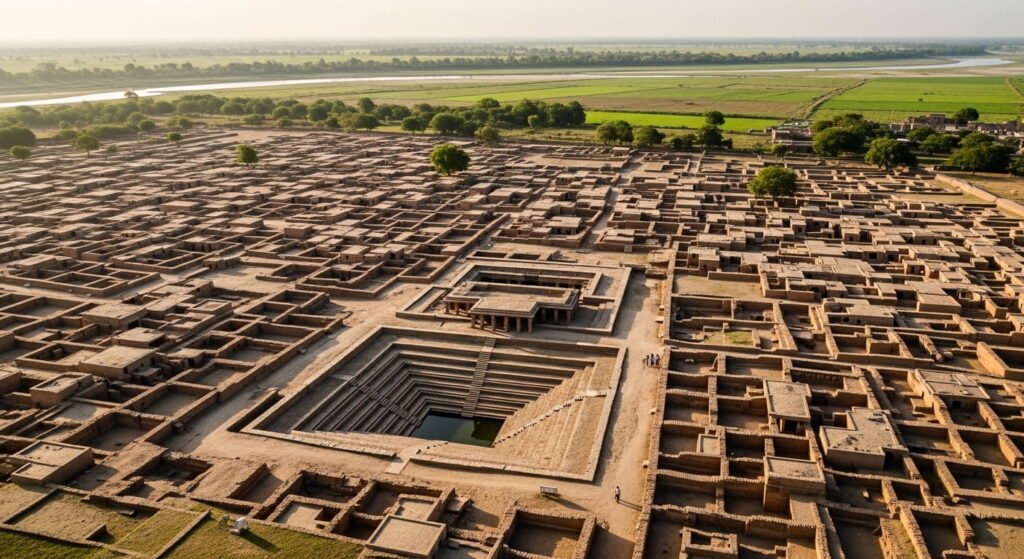

The Indus Valley Civilization mystery remains one of the most fascinating enigmas of the ancient world. Flourishing between 3300 BCE and 1300 BCE, this Bronze Age civilization, also known as the Harappan Civilization, spread across the modern regions of Pakistan and northwest India. The civilization is renowned for its advanced urban planning, architecture, and social organization, yet much about it remains unexplained, including the meaning of its script and the reasons for its decline.
Sites like Harappa and Mohenjo-Daro reveal sophisticated city layouts with grid-patterned streets, elaborate drainage systems, and standardized brick construction, demonstrating remarkable ancient urban engineering. Despite this advancement, the civilization mysteriously disappeared, leaving behind unresolved questions about its social structure, technology, and culture.
This article explores every aspect of the Indus Valley Civilization, including its history, urban planning, governance, writing system, technological innovations, decline, and modern archaeological research.
Historical Background: Origins and Geographic Extent
The Indus Valley Civilization developed along the fertile floodplains of the Indus River, covering an area of over 1.25 million square kilometers. Its urban centers spanned present-day Pakistan, northwest India, and eastern Afghanistan.
Timeline
- Early Harappan Phase (3300–2600 BCE): Small settlements and agricultural development
- Mature Harappan Phase (2600–1900 BCE): Construction of major urban centers like Harappa and Mohenjo-Daro
- Late Harappan Phase (1900–1300 BCE): Gradual decline, regional dispersal, and cultural transformation
The civilization is considered one of the world’s earliest urban societies, alongside Mesopotamia and Ancient Egypt. Its geographic location allowed access to trade routes, fertile lands, and natural resources, contributing to its economic and cultural prosperity.
Urban Planning and Architecture
The cities of the Indus Valley Civilization demonstrate exceptional urban engineering that continues to amaze modern archaeologists.
City Layout
The urban planning of the Indus Valley Civilization was highly organized. Cities were laid out on a precise grid system, with streets oriented north-south and east-west. Residential and public areas were clearly divided, with citadels serving as administrative or public zones and lower towns designated for housing. Some cities were fortified with walls, providing protection against floods and potential attacks. This careful planning reflects the civilization’s advanced approach to urban design and governance.
Drainage and Sanitation
The Indus Valley Civilization featured advanced drainage and sanitation systems. Underground drains ran beneath streets, connecting individual houses to covered sewers, ensuring efficient wastewater management. Public baths, such as the Great Bath of Mohenjo-Daro, highlight both ritualistic and hygienic practices. These sophisticated systems reflect a deep understanding of public health and urban planning, showcasing the civilization’s remarkable engineering skills.
Construction Techniques
The architecture of the Indus Valley Civilization was highly advanced. Buildings were constructed using uniform mud-bricks and baked bricks, standardized in size for consistency. Multi-story structures featured well-planned ventilation and internal courtyards. The presence of granaries, workshops, and storage facilities indicates organized economic activity. Overall, the urban planning and architectural sophistication of the Indus Valley Civilization rivaled that of many later societies, reflecting a high level of social organization and technical knowledge.
Society and Governance
The society of the Indus Valley Civilization was complex, organized, and highly structured, though its political hierarchy remains largely unknown.
Social Organization
The society of the Indus Valley Civilization was likely organized into clan-based communities overseen by a central administrative system. Standardized weights, measures, and brick sizes suggest regulated trade and governance across the region. Archaeological evidence of craftspeople, merchants, and agricultural workers indicates a high degree of occupational specialization, reflecting a complex and well-structured society.
Trade and Economy
The Indus Valley Civilization maintained extensive trade networks with regions such as Mesopotamia, Persia, and the Arabian Peninsula. Traded materials included cotton, beads, metals, and pottery, highlighting the civilization’s economic reach. Agricultural production, including wheat, barley, and domesticated animals, supported population growth and sustained urban centers, demonstrating a well-developed and interconnected economy. The precise governance mechanisms are still debated, but the level of planning and standardization indicates centralized authority or collective regulation.
Writing and Language: The Indus Script Secrets
One of the most enduring mysteries is the Indus script, found on seals, pottery, and other artifacts.
Characteristics
The Indus script is composed of hundreds of symbols, many of which are pictographic in nature. It appears on seals, tablets, and amulets, likely serving purposes related to trade, ritual, or administration. Most examples of the script are written right-to-left, reflecting a consistent writing convention within the civilization.
Challenges in Decipherment
The Indus script remains undeciphered due to several challenges. The lack of bilingual inscriptions, similar to the Rosetta Stone, limits comparative analysis. Most surviving texts are very short, preventing comprehensive study, and the language family underlying the script is unknown, complicating translation efforts. Despite decades of research, the secrets of the Indus script remain unsolved, leaving a significant gap in our understanding of the civilization’s culture, governance, and daily life.
Technological Innovations
The Indus Valley Civilization demonstrated remarkable technological sophistication. Its people mastered metallurgy, producing tools from bronze, copper, and tin. They developed standardized weights and measures to facilitate trade and construction. Craftsmanship flourished, as seen in intricately made beads, pottery, and jewelry. Advanced agriculture and irrigation systems allowed efficient water management to support large populations. Together, these innovations reflect a society capable of complex engineering and organized labor, highlighting the civilization’s advanced technological capabilities.
Decline and Disappearance
The reasons behind the civilization’s decline remain speculative, forming part of the Indus Valley Civilization mystery:
Environmental Changes
Environmental factors likely played a significant role in the decline of the Indus Valley Civilization. Shifts in the course of the Indus River may have caused flooding or water scarcity, disrupting agriculture and settlement patterns. Additionally, deforestation and soil degradation could have further undermined agricultural productivity, contributing to economic and social challenges for the civilization.
Societal Collapse
Archaeological evidence of abandoned cities and toppled structures suggests that internal unrest may have played a role in the decline of the Indus Valley Civilization. Competition for resources or potential conflicts among communities could have further contributed to the gradual urban decline observed across its major settlements.
External Influences
The decline of the Indus Valley Civilization may have been influenced by the arrival of Indo-Aryan groups, which likely contributed to cultural changes. Gradual migration and dispersal of populations also played a role in transforming the region’s social and cultural landscape. While the precise causes remain uncertain, it is likely that a combination of environmental pressures, societal shifts, and external influences contributed to the civilization’s eventual fall.
Archaeological Discoveries
Archaeology has revealed extensive insights into the Indus Valley Civilization:
Major Sites
Key sites of the Indus Valley Civilization reveal its urban sophistication. Harappa was an early urban center, fortified with residential zones and granaries. Mohenjo-Daro is renowned for its Great Bath, citadel, and highly organized drainage system. Dholavira stands out for its water reservoirs and intricate urban layout, while Rakhigarhi, one of the largest settlements, provides evidence of continuity and expansion across the civilization. Together, these sites illustrate the advanced planning and engineering skills of the Indus Valley people.
Artifacts
Archaeological discoveries from the Indus Valley Civilization include seals adorned with animal motifs and inscriptions, terracotta figurines and pottery, and jewelry and beads that reflect advanced craftsmanship and extensive trade networks. These artifacts offer valuable clues about the daily life, economy, and cultural practices of this ancient civilization.
Cultural and Historical Impact
The Indus Valley Civilization had a lasting influence on later South Asian cultures. Its urban planning techniques were adopted in subsequent cities, while its agricultural and trade practices helped shape regional economic development. Artistic styles from the civilization also influenced later craft traditions. On a global scale, the Indus Valley Civilization remains a model of Bronze Age urban sophistication, inspiring scholars and archaeologists studying the development of ancient human societies.
Modern Research and Preservation
Modern research employs advanced methods to uncover new insights into the Indus Valley Civilization. Remote sensing and satellite imagery have revealed previously unknown settlements, while carbon dating and stratigraphy help clarify timelines and the sequence of urban development.
Conservation efforts led by UNESCO protect key sites such as Mohenjo-Daro and Harappa, preserving them for future study. Together, these efforts ensure that the legacy of the Indus Valley Civilization continues to inform our understanding of early urban society.
Challenges and Mysteries
Despite extensive research, several mysteries of the Indus Valley Civilization remain unsolved. Scholars continue to debate the full meaning of the Indus script, the reasons behind the civilization’s sudden urban decline, its social and political hierarchy, and the exact nature of its religious and ritual practices. These unanswered questions contribute to the enduring fascination with the Indus Valley Civilization and its remarkable yet enigmatic achievements.
Conclusion
The Indus Valley Civilization represents one of the earliest examples of a highly organized urban society. Its achievements in ancient urban engineering, social organization, and technological innovation remain unmatched for its time.
Despite extensive archaeological research, many aspects, including the Indus script secrets and the precise reasons for its decline, remain mysterious. These enduring questions continue to fuel global fascination and scholarly research.
The legacy of Harappa, Mohenjo-Daro, and other Indus cities reminds us of the ingenuity, creativity, and resilience of ancient civilizations. The Indus Valley Civilization mystery remains a vital chapter in the story of human history, demonstrating that even millennia later, ancient ingenuity continues to inspire wonder and discovery.
FAQs
Q1: What is the Indus Valley Civilization?
It is an ancient Bronze Age civilization in South Asia, known for urban planning and advanced technology.
Q2: When did the Indus Valley Civilization exist?
It flourished between 3300 BCE and 1300 BCE.
Q3: What were the major cities of the Indus Valley Civilization?
Key sites include Harappa, Mohenjo-Daro, Dholavira, and Rakhigarhi.
Q4: What is the Indus script?
A system of pictographic symbols found on seals and pottery; it remains undeciphered.
Q5: How advanced was the Indus Valley Civilization?
It had standardized bricks, grid-pattern cities, drainage systems, metallurgy, and trade networks.
Q6: Why did the Indus Valley Civilization decline?
Possible causes include environmental changes, resource depletion, internal conflict, and migrations.
Q7: Where can you see artifacts from the Indus Valley Civilization?
Artifacts are housed in museums in India, Pakistan, and globally, including the National Museum of Pakistan and the National Museum in New Delhi.