



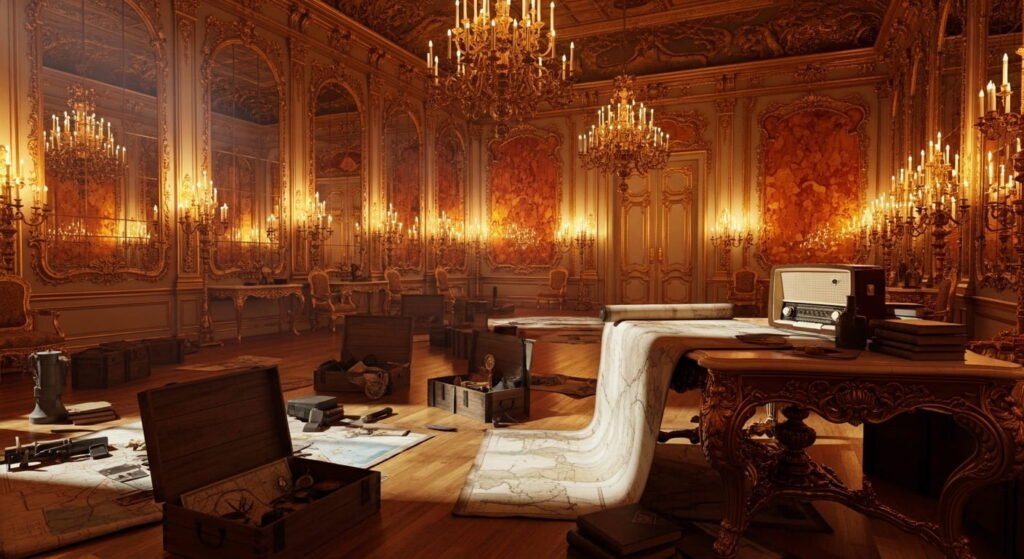

The Amber Room mystery is one of the most captivating unsolved mysteries in art and history. Once hailed as the “Eighth Wonder of the World,” the Amber Room was a chamber decorated entirely with amber panels, gold leaf, and mirrors, originally constructed in the 18th century. Its craftsmanship, beauty, and value made it legendary.
Despite its fame, the lost Amber Room disappeared during World War II, sparking endless speculation, searches, and theories about its fate. Some claim it was hidden in a bunker, sunk in the Baltic Sea, or destroyed during bombing raids. The story of the Amber Room blends artistry, wartime intrigue, and the human obsession with hidden treasure, making it a prime subject of Russian treasure mysteries.
This article provides a deep exploration of the Amber Room: its construction, transfer to Russia, disappearance, modern searches, reconstruction efforts, historical significance, and why it remains one of the world’s most tantalizing lost treasures.
Historical Background: Construction in Prussia
The Amber Room was originally constructed in 1716 in Prussia, commissioned by Frederick I of Prussia. German craftsmen Andreas Schlüter and Gottfried Wolfram worked on the intricate panels, which combined thousands of pieces of amber, gold leaf, and mirrors.
The room was initially installed at Charlottenburg Palace in Berlin. Its vibrant amber panels glimmered in candlelight, creating a mesmerizing effect. Even early visitors described the room as breathtaking, highlighting the unique combination of natural amber, craftsmanship, and artistic ingenuity.
Craftsmanship and Materials
The Amber Room was made of over six tons of amber, intricately carved into decorative panels. The artisans combined amber with gold leaf, mirrors, and precious woods. The room was designed to dazzle viewers and serve as a symbol of Prussian wealth and sophistication. Its combination of art, science, and luxury made it unmatched in Europe. Over time, it became a diplomatic gift, increasing its historical significance.
The Amber Room in Russia
In 1716, Frederick William I of Prussia gifted the Amber Room to Peter the Great of Russia, cementing political alliances between the two nations. It was transported to St. Petersburg and installed in the Winter Palace, where it became part of the Russian royal heritage.
Later, in the 18th century, Empress Elizabeth of Russia relocated the Amber Room to the Catherine Palace in Tsarskoye Selo, outside St. Petersburg. There, it was expanded, redesigned, and enhanced with additional amber panels, gold, and intricate detailing.
By the mid-18th century, the Amber Room had become a symbol of imperial power and artistic achievement, attracting dignitaries, royalty, and scholars from across Europe. Its reputation as the “Eighth Wonder of the World” grew, making it a treasure of immense historical and cultural significance.
World War II Disappearance
The Amber Room’s fame made it a target during World War II. In 1941, Nazi Germany invaded the Soviet Union, occupying St. Petersburg (then Leningrad) and surrounding areas. The Amber Room was dismantled by German forces and transported to Königsberg (modern-day Kaliningrad).
Transport and Storage
The room was carefully packed in wooden crates, along with blueprints and documentation, and moved to Königsberg Castle. During this period, it was displayed for Nazi officials, including Hermann Göring, and remained under German control until the later stages of the war.
Disappearance
In 1945, as Allied forces advanced and bombings intensified, the Amber Room vanished without a trace, giving rise to multiple theories about its fate. Some suggest it was destroyed during bombing raids by either Allied or Soviet forces. Others believe it was hidden in a bunker or underground tunnels in Königsberg or nearby areas. Another theory proposes that the room was loaded onto a ship and sunk in the Baltic Sea. Rumors also persist that high-ranking Nazi officials, such as Hermann Göring, may have hidden it for personal gain. Despite numerous searches and investigations, no conclusive evidence of the Amber Room’s location has ever been found, solidifying its status as a legendary lost treasure.
Theories of Its Fate
Hidden Bunkers
Historians and treasure hunters often speculate that the Amber Room was hidden in a secret Nazi bunker, designed to protect looted treasures. Reports of abandoned bunkers in Eastern Prussia fuel this theory.
Sunk in the Sea
Some researchers propose the crates containing the Amber Room were loaded onto ships that sank in the Baltic Sea. Wreckage found off the coast of Poland and Germany has been explored, but no definitive confirmation exists.
Destroyed During Bombings
Bombing raids in Königsberg may have destroyed the Amber Room. Some post-war investigators claim that heavy destruction and fire reduced the treasure to ashes, though others believe this is unlikely given the meticulous dismantling and packaging.
Modern Searches and Excavations
Searches for the lost Amber Room continue to this day, involving archaeologists, historians, and private treasure hunters.
Russian Investigations
Russia has conducted multiple searches near Königsberg, using historical records, eyewitness accounts, and modern technology. Excavations have uncovered remnants of crates, tunnels, and other wartime artifacts, but not the room itself.
International Efforts
International researchers have joined the hunt, exploring locations in Germany, Poland, and the Baltic Sea. Ground-penetrating radar, sonar scans, and historical mapping have all been applied to locate hidden chambers or shipwrecks.
Challenges in Discovery
Modern searches face significant challenges:
- Destruction of Königsberg during the war
- Scarcity of reliable records from WWII
- Submerged and inaccessible locations
- Political and logistical limitations on excavation
Despite these difficulties, hope remains that the Amber Room will one day be recovered.
Reconstruction Efforts
Recognizing the cultural loss, Russian authorities initiated a reconstruction of the Amber Room at the Catherine Palace.
1979–2003 Reconstruction
The project began in 1979 and took over two decades to complete. Artisans painstakingly recreated amber panels, mirrors, and gold detailing using historical records, photographs, and sketches. The recreated Amber Room was completed in 2003 and now serves as a major tourist attraction, symbolizing both loss and human dedication to preserving history.
Significance of the Reconstruction
While the reconstruction cannot replace the original, it highlights the Amber Room’s artistic, cultural, and historical importance. It also preserves techniques and craftsmanship that might have been lost forever.
Cultural and Historical Significance
The Amber Room continues to symbolize multiple facets of human fascination. It represents artistic mastery, being an unparalleled example of Baroque interior design, and stands as a significant piece of cultural heritage, treasured by both Russia and Europe. The room also embodies historical intrigue, reflecting the mysteries surrounding World War II looting and lost art. Its story has inspired documentaries, films, and books, fueling popular fascination. Today, the Amber Room is regarded as one of the most famous lost treasures in history, bridging the worlds of art history, treasure hunting, and wartime mystery.
Notable Clues and Artifacts
Several clues hint at the Amber Room’s fate:
- Crates labeled and documented during WWII
- Photographs of the room in Königsberg prior to disappearance
- Eyewitness testimonies from German soldiers and locals
- Partial remains of crates and panels discovered post-war
While these clues provide tantalizing hints, none have led to a definitive recovery.
Why the Mystery Persists
The mystery of the Amber Room endures due to several factors. Wartime destruction and poor record-keeping have obscured its fate, while the complexity of its dismantling and transport during World War II adds to the uncertainty. Possible submerged or hidden locations remain unexplored, and the room’s legendary status continues to fuel treasure hunting efforts. The combination of its historical significance, artistic value, and wartime intrigue ensures that the Amber Room remains one of Russia’s most captivating treasure mysteries.
Conclusion
The Amber Room remains one of the most compelling lost treasures in the world. Its disappearance during WWII, combined with its extraordinary craftsmanship, historical significance, and mystery, has cemented its place in history as a legendary lost masterpiece. Despite the completed reconstruction at the Catherine Palace, the allure of the original lost Amber Room continues to inspire explorers, historians, and treasure hunters worldwide.
Whether hidden in a bunker, sunk at sea, or destroyed, the Amber Room embodies the enduring fascination with art, history, and the human desire to recover the past. The Amber Room mystery is far more than a story of lost art—it is a symbol of resilience, ambition, and the eternal quest to uncover one of history’s greatest secrets.
FAQs
Q1: What happened to the Amber Room?
The Amber Room disappeared during WWII after being looted by Nazi forces; its current location is unknown.
Q2: Has the Amber Room ever been recovered?
No. Despite numerous searches, the original Amber Room has never been found.
Q3: Where was the Amber Room located before WWII?
It was installed in the Catherine Palace near St. Petersburg, Russia, and later moved to Königsberg by German forces.
Q4: What is the Amber Room made of?
It consists of thousands of amber panels, gold leaf, and mirrors, showcasing 18th-century craftsmanship.
Q5: Has the Amber Room been reconstructed?
Yes. A reconstruction at the Catherine Palace was completed in 2003, based on historical records and photographs.
Q6: Why is the Amber Room famous?
It is famous for its beauty, intricate craftsmanship, and mysterious disappearance during WWII.
Q7: Could the Amber Room still exist?
Yes. Theories suggest it could be hidden in bunkers, shipwrecks, or underground tunnels, but no evidence has confirmed its survival.