



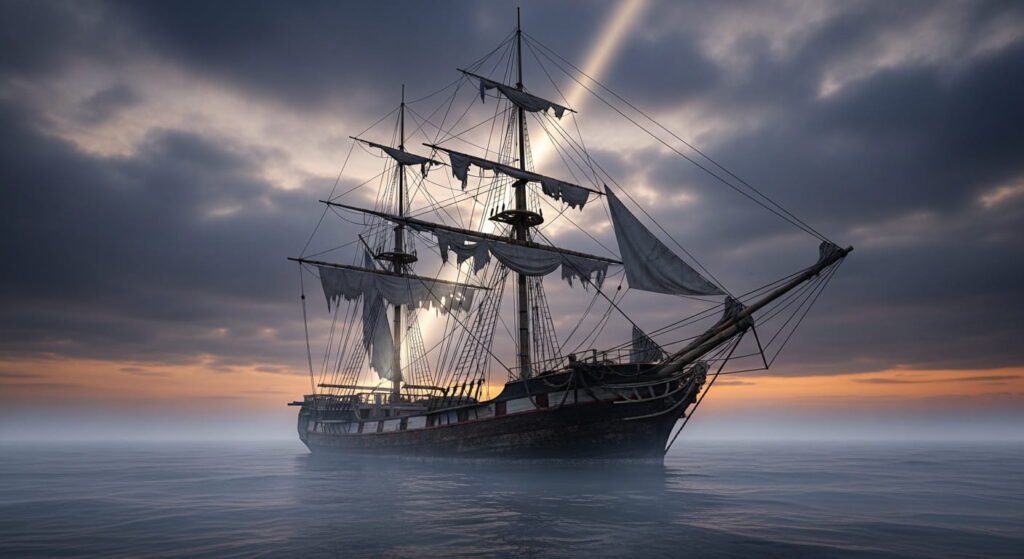

Among all maritime mysteries ever recorded, few stories are as haunting, debated, and endlessly searched as the case of the Mary Celeste ghost ship. In December 1872, this American merchant vessel was discovered drifting alone in the Atlantic Ocean near the Azores Islands. The ship was not wrecked. It was not burning. It was not sinking. Instead, it was eerily intact. The cargo remained largely untouched. Food and water supplies were still available. Personal belongings sat undisturbed inside cabins. But every single person on board had vanished.
Captain Benjamin Briggs, his wife Sarah, their two-year-old daughter Sophia, and seven experienced crew members vanished without explanation. Searchers found no bodies, and the crew sent no distress signals. Authorities never received any confirmed sightings of survivors.
The Mary Celeste mystery has endured for more than 150 years because it presents a puzzle with no violence, no clear crime, and no obvious disaster. It is one of the most famous ghost ship stories in maritime history.
This complete investigation explores the full story of the Mary Celeste ghost ship — its origins, its final voyage, the shocking discovery, official investigations, leading theories, media exaggerations, and modern scientific explanations.
The Ship Before It Became a Legend
The vessel that would later become the Mary Celeste was originally built in 1861 in Nova Scotia, Canada. It was first named the Amazon. During its early years, the ship experienced a series of minor misfortunes, including collisions and ownership disputes. These events later fueled superstition, although at the time they were considered ordinary maritime incidents.
In 1869, the owners repaired the ship, changed its name to Mary Celeste, and put it under new management. By 1872, a group of American investors, including Captain Benjamin Spooner Briggs, owned the vessel.
Captain Briggs did not chase risky voyages as an inexperienced sailor. He earned respect as a disciplined sea captain, known for his strong religious values and careful navigation.He had commanded several successful journeys before taking control of the Mary Celeste. When the ship prepared for its 1872 voyage, there was no sign that it would soon become one of history’s most famous abandoned ships.
The Final Voyage Begins
On November 7, 1872, the Mary Celeste departed from New York Harbor. Its destination was Genoa, Italy. The ship carried 1,701 barrels of industrial alcohol. This cargo was intended for fortifying wines. On board were Captain Briggs, his wife Sarah, their young daughter Sophia, and seven crew members carefully selected for their experience and reliability.
The departure was normal. Weather conditions at the time were not extreme. There were no recorded major storms during the early part of the journey. About eight days later, on November 15, the British ship Dei Gratia left New York Harbor, traveling along a similar route toward Gibraltar. The two captains, Briggs and David Morehouse of the Dei Gratia, knew each other personally. No one could have predicted that their ships would meet again under such strange circumstances.
The Discovery in the Atlantic
On December 4, 1872, nearly a month after the Mary Celeste left New York, sailors aboard the Dei Gratia spotted a ship behaving strangely in the distance. It was sailing erratically, with some sails partially set but no visible crew on deck. Captain Morehouse recognized the vessel as the Mary Celeste. Concerned, he ordered a boarding party to investigate.
The boarding crew stepped onto a ship that felt frozen in time. There were no signs of battle. No blood. No weapons drawn. The ship had about three and a half feet of water in its hold, which was not unusual for a vessel of its type. The pumps were partially disassembled but still functional.
The cargo was mostly intact. Some barrels were empty, but later investigation showed these were made of porous red oak and likely leaked naturally. The captain’s cabin contained personal belongings, clothing, and valuables. Nothing appeared looted.
The only items missing were the ship’s lifeboat and key navigational instruments such as the sextant and marine chronometer. The final logbook entry was dated November 25, 1872. The recorded position placed the ship about 400 miles east of the Azores. Nine days later, the Mary Celeste was found drifting — completely abandoned.
The Gibraltar Investigation
After being sailed to Gibraltar by a salvage crew from the Dei Gratia, the Mary Celeste became the focus of a formal maritime inquiry. The British Attorney General, Frederick Solly-Flood, suspected foul play. He questioned whether the crew of the Dei Gratia had murdered those aboard the Mary Celeste in order to claim salvage rights.
However, no evidence supported this suspicion. There were no bloodstains. No bullet holes. No signs of combat. The court examined the cargo and ship structure. While minor damage existed, nothing suggested violent attack.
Eventually, the Dei Gratia crew was cleared of wrongdoing and awarded partial salvage payment. The investigation ended without identifying a definitive cause for the crew’s disappearance. The Mary Celeste mystery remained unsolved.
Leading Theories Behind the Mary Celeste Mystery
Over the decades, numerous theories have attempted to explain what happened aboard the Mary Celeste ghost ship.
One theory suggests mutiny. However, Captain Briggs was widely respected, and there was no evidence of internal conflict. Moreover, a mutiny would likely involve theft or course alteration. Neither occurred. Another theory involves piracy. Yet pirates typically stole cargo and valuables. In this case, both remained largely untouched. There were no signs of struggle.
The most widely accepted modern theory centers on the alcohol cargo. Industrial alcohol produces highly flammable vapors. If fumes built up inside the hold, they may have created pressure or small explosions. Modern experiments show that alcohol vapor explosions can occur without leaving burn marks.
It is possible that Captain Briggs feared a catastrophic explosion. He may have ordered the crew to temporarily abandon the ship using the lifeboat, intending to return once danger passed. If the lifeboat was tied to the ship and a sudden storm or wave snapped the rope, the occupants would have been left stranded at sea. This theory explains why personal belongings remained untouched and why navigational instruments were missing. It suggests a temporary evacuation that became permanent tragedy.
Other explanations include rogue waves, waterspouts, seaquakes, or structural fears caused by unusual noises within the hull. None of these theories can be proven with absolute certainty.
The Role of Fiction and Media
The legend of the Mary Celeste ghost ship expanded dramatically after fictional accounts were published. In 1884, author Arthur Conan Doyle published a fictional story inspired by the event. His version included exaggerated violence and conspiracy elements not supported by historical evidence. Newspapers also added sensational details over time. These fictional additions blurred the line between fact and myth, increasing public fascination.
Paranormal and Supernatural Claims
Because investigators found the Mary Celeste abandoned without visible damage, people naturally developed supernatural theories. Some linked the ship to the Bermuda Triangle, even though it lay outside the area’s commonly defined boundaries. Others suggested sea monsters, giant squid attacks, or curses. In reality, there is no credible scientific evidence supporting paranormal explanations. The ocean is vast and unpredictable. Natural explanations are more consistent with available evidence.
Modern Analysis and Maritime Perspective
Modern maritime historians generally agree that panic likely played a central role. A combination of leaking alcohol fumes, pressure build-up, minor flooding, and possibly rough seas could have created a frightening scenario. Without modern communication systems, once separated from the main vessel, survival chances would have been extremely low. The Atlantic Ocean is unforgiving. A small lifeboat in winter conditions would stand little chance against waves, currents, and exposure. This explanation, while tragic, aligns with physical evidence and maritime knowledge.
Why the Mystery Endures
The Mary Celeste ghost ship continues to fascinate people because it lacks closure. There was no wreck. No debris field appeared, and no survivors emerged to tell the story. Not a single body ever washed ashore. The ship itself became a silent witness. Its condition suggested order, not chaos. That quiet order makes the disappearance more unsettling. The mystery represents humanity’s fear of the unknown — especially the unknown depths of the sea.
Cultural Impact
The Mary Celeste has inspired books, documentaries, films, and academic research. It is often referenced as the ultimate ghost ship. In maritime folklore, the name Mary Celeste symbolizes unexplained abandonment. The story also serves as a reminder of the dangers faced by 19th-century sailors navigating vast oceans without modern technology.
Conclusion
The Mary Celeste ghost ship remains one of the most compelling unsolved maritime mysteries in history. While modern evidence supports the alcohol vapor and panic evacuation theory, absolute proof is unlikely to emerge after more than 150 years. There is no solid evidence of mutiny, piracy, aliens, or supernatural forces.
What remains is a powerful story of disappearance — a seaworthy ship drifting alone across the Atlantic, carrying unanswered questions. The Mary Celeste does not frighten us because of visible horror. It haunts us because of silence.
FAQs
What happened to the Mary Celeste ghost ship?
The Mary Celeste was found abandoned in 1872 near the Azores Islands. The crew disappeared without signs of violence or piracy, and their fate remains unknown.
Was the Mary Celeste found in the Bermuda Triangle?
No, the Mary Celeste was discovered near the Azores in the Atlantic Ocean, outside the commonly defined Bermuda Triangle area.
Was there evidence of piracy on the Mary Celeste?
No. The cargo and valuables were largely untouched, and there were no signs of struggle.
What is the most accepted theory about the Mary Celeste?
Most historians believe alcohol vapor from the cargo caused panic, leading the crew to temporarily abandon ship in the lifeboat.
Were any bodies from the Mary Celeste ever found?
No confirmed bodies of the captain, crew, or passengers were ever recovered.
Why is the Mary Celeste called a ghost ship?
It is called a ghost ship because it was discovered completely abandoned but still seaworthy.