




Stonehenge stands as one of the most iconic prehistoric monuments in the world. Located on Salisbury Plain in Wiltshire, England, this ancient stone circle has fascinated historians, archaeologists, engineers, and travelers for centuries. Despite more than a hundred years of excavation and scientific analysis, Stonehenge remains one of the greatest unsolved historical mysteries.
How did Neolithic communities move and erect stones weighing up to 25 tons? Why was the monument constructed in carefully planned stages over many centuries? Was it an astronomical observatory, a sacred ceremonial site, a burial ground, or something more complex?
The mystery of Stonehenge is not built on legend alone. It is grounded in real archaeological questions, evolving scientific discoveries, and debates among experts. This article explores the complete story of Stonehenge—its origins, construction, cultural context, leading theories, and modern research—offering a comprehensive look at one of the most puzzling ancient monuments ever built.
The Origins of Stonehenge
Early Earthworks (c. 3000 BCE)
The earliest phase of Stonehenge began around 3000 BCE. At this stage, the site was not yet a stone circle. Instead, it consisted of a circular ditch and bank enclosure about 110 meters in diameter. Inside the enclosure were 56 pits known as the Aubrey Holes. Archaeological evidence shows that some of these pits contained cremated human remains. This indicates that Stonehenge initially functioned as a burial site. It may have been one of the largest Neolithic cemeteries in Britain at the time.
This early funerary use is significant because it suggests that Stonehenge began as a sacred landscape long before the massive stones were erected.
The Arrival of the Bluestones
Around 2500 BCE, builders transported smaller stones known as bluestones to the site. These stones originated in the Preseli Hills of Wales, over 200 kilometers away. Geological analysis has confirmed their source. The transportation of these stones is one of the most debated aspects of the Stonehenge mystery. Several theories exist:
- They were dragged across land using wooden sledges.
- They were transported via rivers and coastal routes.
- Glaciers may have moved them part of the way during the Ice Age.
Most researchers now support human transportation rather than natural glacial movement. Experimental archaeology has shown that large teams could move heavy stones using ropes, timber rollers, and coordinated effort. The fact that these stones were brought from such a distant region suggests that Stonehenge held significant cultural or spiritual importance.
The Sarsen Stones and Monumental Architecture
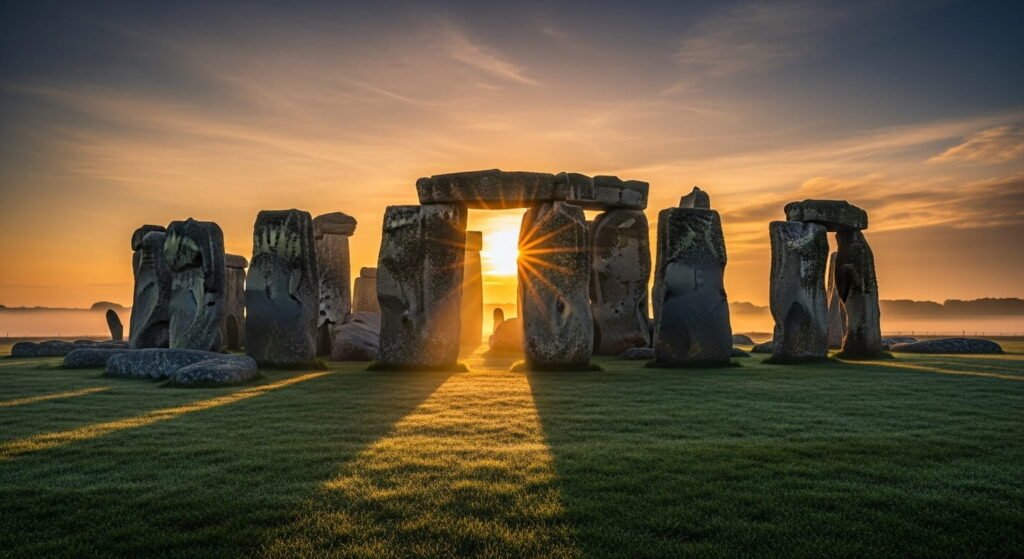
The most visually striking elements of Stonehenge are the massive upright stones called sarsens. These stones were likely sourced from Marlborough Downs, approximately 20 miles north of the site. Weighing up to 25 tons each, the sarsens were arranged in a circular outer ring with horizontal lintel stones placed on top. The inner horseshoe-shaped structure was also carefully aligned.
What makes this construction extraordinary is the precision of the stonework. The builders used mortise-and-tenon joints—a technique commonly associated with woodworking—to lock the stones together. The lintels were curved to match the circular layout. This level of engineering suggests advanced planning, skilled craftsmanship, and a highly organized workforce.
Engineering Challenges and Construction Methods
One of the most enduring ancient engineering mysteries is how prehistoric builders erected these enormous stones without metal tools or modern machinery.
Researchers believe the process likely involved:
- Digging deep pits with sloped ramps.
- Positioning stones upright using ropes and wooden frames.
- Filling the base with compacted earth and stone to secure stability.
- Levering horizontal lintels into place using raised platforms.
Modern experiments have demonstrated that such methods are possible using only Neolithic technology. However, the exact sequence and logistics remain partly speculative. The construction required not only physical strength but also social organization. Coordinating labor, transporting materials, and maintaining food supplies would have required leadership and planning.
Astronomical Alignments and Solar Observations
One of the strongest and most widely accepted theories is that Stonehenge functioned as an astronomical calendar. The monument aligns precisely with the sunrise on the summer solstice and the sunset on the winter solstice. During the summer solstice, the sun rises directly above the Heel Stone, creating a dramatic visual alignment.
This suggests that the builders had a sophisticated understanding of solar movements. For agricultural societies, tracking seasonal cycles was essential for farming. However, scholars debate whether Stonehenge was purely an observatory or whether astronomical alignment was symbolic within a broader religious framework.
Religious and Ceremonial Significance
Archaeological discoveries around Stonehenge reveal that it was part of a much larger ritual landscape. Nearby, researchers uncovered Durrington Walls, a large Neolithic settlement. Evidence of feasting, animal remains, and large gatherings suggests that people traveled to the area during significant seasonal events.
Stonehenge may have served as a ceremonial center connected to life, death, and renewal. The alignment with solstices could symbolize the cycle of life and rebirth. Burial remains found at the site support the idea that Stonehenge was associated with ancestor worship or elite individuals.
Healing and Pilgrimage Theories
Some researchers propose that Stonehenge functioned as a prehistoric healing center. Skeletal remains found nearby show signs of injury and disease. Isotope analysis indicates that some individuals traveled from distant regions.
The bluestones were believed, in later folklore, to have healing powers. Although there is no direct proof that Neolithic builders believed this, the long-distance transport of the stones suggests symbolic importance. This has led some experts to describe Stonehenge as a place of pilgrimage.
Modern Scientific Research and Discoveries
In recent decades, advanced technology has significantly improved our understanding of Stonehenge.
Radiocarbon Dating
Radiocarbon analysis has refined the timeline of construction phases, confirming that the monument evolved over centuries rather than being built at once.
Isotope Analysis
Isotope testing of human teeth and bones reveals that some individuals buried at Stonehenge grew up in Wales, supporting long-distance cultural connections.
Ground-Penetrating Radar
Non-invasive scanning techniques have uncovered previously unknown pits, structures, and pathways beneath the surrounding landscape.
DNA Research
Genetic studies indicate that the builders were part of Neolithic farming communities that migrated from continental Europe thousands of years earlier. Despite these discoveries, no single explanation fully answers the central question: what was Stonehenge’s primary purpose?
Why Stonehenge Remains a Historical Enigma
Stonehenge remains an unsolved archaeological mystery because:
- There are no written records from its builders.
- Its function likely changed over time.
- Multiple interpretations fit the available evidence.
- Cultural beliefs of Neolithic societies are difficult to reconstruct.
Rather than one simple answer, Stonehenge may represent a combination of astronomical, ceremonial, political, and social functions. Its enduring mystery lies in the gap between physical evidence and human meaning.
Cultural Impact and Global Recognition
Today, Stonehenge is a UNESCO World Heritage Site and one of the most visited ancient landmarks in Europe. It has become a symbol of prehistoric ingenuity and spiritual curiosity. Each year, thousands gather at the site during solstice events. While modern spiritual practices are not directly linked to the original builders, they reflect the monument’s continued symbolic power. Stonehenge has inspired countless documentaries, research projects, and academic studies. It remains central to discussions about prehistoric Britain and ancient monument construction.
Conclusion
The mystery of Stonehenge continues to captivate scholars and visitors alike. Archaeology has answered many questions about its timeline, materials, and construction techniques. Modern science has revealed its connections to wider Neolithic communities and ceremonial landscapes. Yet the deeper meaning behind its creation—what it truly represented to its builders—remains partially hidden in the distant past. Stonehenge stands not only as an ancient stone circle but as a testament to human creativity, organization, and spiritual expression. Even after thousands of years, it challenges us to look beyond the stones and consider the lives, beliefs, and ambitions of the people who built it.
FAQs
1. Who built Stonehenge?
Stonehenge was constructed by Neolithic farming communities in Britain between 3000 BCE and 1500 BCE.
2. How were the massive stones transported?
Researchers believe the stones were moved using wooden sledges, rollers, ropes, and possibly river routes.
3. Is Stonehenge an astronomical observatory?
It aligns with the summer and winter solstices, suggesting an important connection to solar observations.
4. Was Stonehenge a burial site?
Yes, cremated human remains indicate that it served as a cemetery, especially in its early phases.
5. Why is Stonehenge still considered a mystery?
Although we understand how and when it was built, its primary purpose and symbolic meaning remain debated.