




The Nazca Lines of Peru are one of the most fascinating and mysterious archaeological wonders ever discovered. Etched into the dry desert plains of southern Peru, these massive drawings stretch across miles of land and can only truly be understood from above. For nearly a century, scientists, historians, explorers, and conspiracy theorists have tried to uncover the truth behind their creation. How did an ancient civilization living more than 2,000 years ago create such enormous designs without modern technology? Why were these giant shapes carved into the earth? And what purpose did they serve?
The Nazca Lines of Peru continue to capture global attention because they combine art, religion, astronomy, engineering, and mystery. Some people believe they were sacred symbols created to communicate with gods. Others claim they are evidence of alien contact. Modern research offers scientific explanations, yet many questions still remain.
This article explores everything about the Nazca Lines of Peru in complete detail. We will examine their history, discovery, construction techniques, cultural meaning, alien theories, modern research, preservation challenges, and why this Peru archaeological mystery remains one of the most searched topics online.
Location and Geographic Setting
The Nazca Lines are located in the Nazca Desert of southern Peru, roughly 250 miles south of Lima. They lie between the towns of Nazca and Palpa on a wide desert plateau known as the Pampa Colorada.
The Nazca Desert is one of the driest places on Earth. Some areas receive almost no rainfall throughout the year. The ground is covered with reddish-brown stones that contain iron oxide, giving the surface a dark appearance. Beneath this top layer lies lighter-colored soil. When the surface stones are removed, the lighter soil becomes visible, creating a strong visual contrast.
This extremely dry climate plays a crucial role in preserving the Nazca Lines of Peru. There is little rain, minimal wind, and almost no vegetation. Because of these conditions, the geoglyphs have survived for more than two millennia with surprisingly little damage. In 1994, UNESCO officially recognized the Nazca Lines as a World Heritage Site, confirming their global cultural importance.
What Exactly Are the Nazca Lines?
The Nazca Lines of Peru are massive geoglyphs. A geoglyph is a large design formed on the ground by arranging or removing natural materials. In the case of the Nazca geoglyphs, the ancient people scraped away the top layer of dark stones to reveal lighter soil underneath.
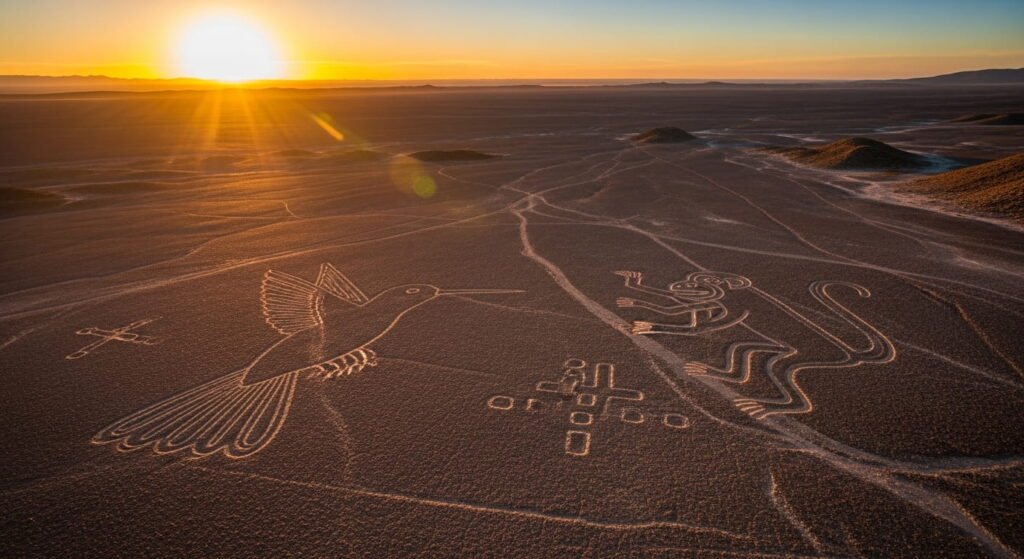
There are more than 800 straight lines stretching across the desert. Some run perfectly straight for several miles. In addition to straight lines, there are hundreds of geometric shapes including trapezoids, triangles, rectangles, and spirals. Most impressive of all are the animal and plant figures carved into the desert floor.
Among the most famous figures are the Hummingbird, the Monkey, the Spider, the Condor, the Whale, the Dog, and a strange humanoid shape often called the Astronaut. Some of these figures measure over 1,000 feet in length. The sheer size of the Nazca Lines of Peru makes them almost impossible to fully appreciate from ground level. They were clearly designed to be viewed from above, yet the Nazca civilization had no aircraft. This paradox is one of the main reasons the Nazca desert mystery continues to fascinate researchers.
Discovery and Early Research
Although local communities were aware of the lines for centuries, the Nazca Lines of Peru gained international attention in the 1920s when commercial pilots flying over southern Peru noticed strange patterns on the desert floor. From the air, the massive designs became clearly visible.
In the 1930s, American historian Paul Kosok began studying the Nazca Lines. He proposed that some lines aligned with the setting sun during the winter solstice. This observation led to the idea that the Nazca geoglyphs might function as a giant astronomical calendar.
Later, German mathematician and archaeologist Maria Reiche dedicated her life to researching and protecting the Nazca Lines of Peru. She spent decades measuring and mapping the lines by hand. Reiche strongly supported the astronomical theory and believed the desert functioned as a massive observatory. Her work played a crucial role in bringing global recognition to the site and helping secure its protection.
The Nazca Civilization
The Nazca civilization flourished between approximately 500 BCE and 500 CE. They lived in one of the harshest environments in South America. Despite the desert conditions, they developed advanced agricultural systems by constructing underground aqueducts known as puquios. Some of these aqueduct systems are still functioning today.
The Nazca people were also skilled potters and textile artists. Their ceramics often featured colorful depictions of animals and mythological figures. Interestingly, many of the animals seen in Nazca pottery also appear in the Nazca Lines of Peru. This artistic connection supports the idea that the geoglyphs were culturally significant rather than random designs.
The Nazca civilization was organized and capable of large-scale cooperation. Creating the Nazca geoglyphs would have required planning, coordination, and communal effort. This suggests the lines had strong social or religious importance.
How Were the Nazca Lines Constructed?
One of the most common questions about the Nazca Lines of Peru is how they were created without aerial technology. Archaeological evidence shows that the Nazca people used simple tools. Wooden stakes discovered at several sites suggest that ropes were tied between them to create perfectly straight lines. By placing stakes in the ground and connecting them with rope, the Nazca could measure long distances accurately.
To create large animal figures, they likely used a scaling technique. A small drawing could be divided into a grid. Each square of the grid could then be enlarged proportionally on the desert floor. This method is still used by artists today to create large murals.
The desert surface itself made construction easier. The top layer of stones could be removed quickly, exposing the lighter soil underneath. Because there was little rainfall, the lines remained visible for centuries. The creation of the Nazca Lines of Peru did not require advanced technology. It required patience, organization, and knowledge of geometry.
Theories About Their Purpose
The purpose of the Nazca Lines remains debated. However, modern research supports several main theories. Many scholars believe the Nazca Lines of Peru were part of religious rituals. The Nazca people depended heavily on water for survival. Drought could destroy crops and threaten the entire community. It is possible that the lines were created as offerings to gods associated with rain and fertility.
Some researchers suggest that people walked along the lines during ceremonies. The straight paths may have served as ritual walkways. The act of walking the lines might have been a spiritual practice meant to honor deities. Another theory links the Nazca geoglyphs to underground water sources. Studies indicate that some lines point toward aquifers. This suggests a possible connection between the Nazca Lines and water management.
The astronomical theory, once widely accepted, is now viewed with caution. While certain lines align with celestial events, most do not. Modern archaeologists believe astronomy may have played a minor role but was not the primary purpose.
The Nazca Alien Theory
No discussion of the Nazca Lines of Peru would be complete without addressing the alien theory. In 1968, Swiss author Erich von Daniken published the book Chariots of the Gods. In this book, he suggested that ancient civilizations received help from extraterrestrials. He claimed the Nazca Lines were landing strips for alien spacecraft.
This Nazca alien theory became extremely popular and still appears frequently in online searches. The idea that the lines were created as messages to beings in the sky captured the public imagination. However, scientists strongly reject this claim. The Nazca Lines are shallow grooves in the ground and could not support spacecraft. There is no physical evidence of alien contact in the Nazca region. The alien theory remains part of popular culture but lacks scientific support.
Modern Discoveries and Technology
In recent years, new technology has transformed the study of the Nazca Lines of Peru. Drones, satellite imaging, and artificial intelligence have revealed dozens of previously unknown geoglyphs. Japanese researchers announced the discovery of new animal figures in 2019 and 2020. These smaller geoglyphs had been overlooked due to erosion and distance.
Artificial intelligence has helped researchers scan vast areas of desert quickly. This technology continues to expand our understanding of the Nazca desert mystery. Each new discovery reminds us that the Nazca Lines of Peru still hold secrets.
Preservation and Modern Threats
Although the desert preserved the lines for centuries, modern threats pose serious risks. Illegal mining operations have damaged parts of the region. Tourism, while economically important, must be carefully managed to prevent harm. In 2018, a truck driver illegally entered the protected zone and caused visible damage. Climate change may also increase rainfall in the region, potentially affecting preservation. Efforts are ongoing to protect this Peru archaeological mystery for future generations.
Why the Nazca Lines Still Fascinate the World
The Nazca Lines of Peru continue to rank among the most searched archaeological mysteries because they combine scale, beauty, and unanswered questions. They represent human creativity on a massive level. These monuments challenge our understanding of ancient capabilities. Such structures inspire debate about religion, astronomy, engineering, and even extraterrestrial life.
Unlike many ancient structures, the Nazca geoglyphs were not built upward into the sky. They were carved into the earth itself. Their message is horizontal, not vertical. Yet somehow, they were meant to be seen from above. This paradox keeps the Nazca desert mystery alive.
Conclusion
The Nazca Lines of Peru are not alien runways or unexplained supernatural phenomena. They are powerful evidence of the intelligence and spirituality of the ancient Nazca civilization. Created more than 2,000 years ago, these giant geoglyphs reflect religious devotion, social cooperation, and artistic expression. Modern research continues to uncover new details, but the deeper meaning behind the lines may never be fully understood.
What is certain is that the Nazca Lines of Peru remain one of humanity’s greatest archaeological achievements. They stand as a reminder that ancient people were capable of extraordinary creativity and vision. The desert may be silent, but the Nazca Lines continue to speak.
FAQs
What are the Nazca Lines of Peru?
They are giant geoglyphs created by the Nazca civilization between 500 BCE and 500 CE.
Why were the Nazca Lines made?
Most experts believe they were created for religious ceremonies related to water and fertility.
Did aliens create the Nazca Lines?
There is no scientific evidence supporting alien involvement.
How old are the Nazca Lines?
They are over 2,000 years old.
Can tourists visit the Nazca Lines?
Yes, tourists can view them from aircraft tours in southern Peru.