




The Pyramids of Giza stand as one of the most enduring marvels of human history. Towering above the desert sands of Egypt, these ancient monuments have fascinated explorers, archaeologists, historians, and the general public for millennia. They are not only architectural feats but also symbols of power, religion, and ingenuity.
The Pyramids of Giza construction mystery revolves around one question: how did the ancient Egyptians, with no modern machinery, build structures of such precision, scale, and complexity? Despite centuries of study, scholars still debate the techniques, labor systems, and astronomical knowledge used to construct these massive monuments.
The Great Pyramid of Khufu, also known as Cheops, remains the largest and most enigmatic pyramid. Its precise alignment with the cardinal points, incredible accuracy in measurements, and massive limestone blocks weighing several tons have fueled theories ranging from advanced engineering techniques to lost knowledge and even extraterrestrial assistance.
This article explores the Pyramids of Giza in full detail. We cover their historical context, construction methods, modern discoveries, cultural significance, alternative theories, and the reasons this mystery continues to captivate people worldwide.
Location and Historical Context
The Pyramids of Giza are located on the Giza Plateau, on the outskirts of modern Cairo, Egypt. This desert plateau became the burial ground for the Pharaohs during Egypt’s Old Kingdom period (c. 2686–2181 BCE).
The Giza complex includes three main pyramids:
- The Great Pyramid of Khufu (Cheops)
- The Pyramid of Khafre (Chephren)
- The Pyramid of Menkaure
Alongside these are the Sphinx, cemeteries, temples, and smaller “queen” pyramids. The pyramids were constructed during Egypt’s Fourth Dynasty, when centralized power, economic stability, and religious belief enabled large-scale projects.
The plateau itself is geologically favorable for construction. The limestone bedrock provides a stable foundation, and the nearby Nile River offered transport for building materials. However, the scale and precision of the construction remain astonishing, even given these advantages.
The Great Pyramid of Khufu
The Great Pyramid of Khufu is the centerpiece of the Giza complex. It originally stood at 481 feet (146.6 meters), making it the tallest man-made structure in the world for over 3,800 years.
Design and Precision
The pyramid consists of an estimated 2.3 million limestone blocks, each weighing between 2.5 and 15 tons. Some granite blocks in the King’s Chamber weigh over 50 tons. The base covers 13 acres and is aligned with the cardinal points almost perfectly. Modern measurements show the pyramid deviates less than one degree from true north.
The interior chambers, including the King’s Chamber, Queen’s Chamber, and Grand Gallery, display meticulous engineering. Passageways, ventilation shafts, and structural designs indicate an understanding of weight distribution and construction planning far beyond what many historians initially assumed for ancient civilizations.
Construction Theories
Despite extensive research, the exact methods used to build the Pyramids of Giza remain unknown. Several leading theories exist:
Ramp Systems
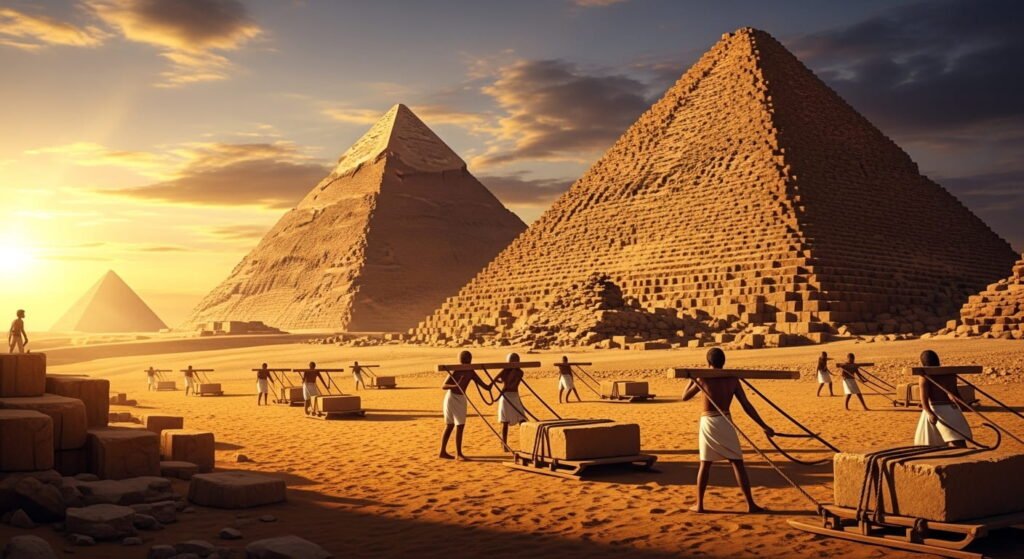
One of the oldest explanations involves ramps. Scholars suggest that workers hauled the massive blocks along straight, zigzagging, or spiral ramps.
- Straight ramps would have required enormous amounts of material.
- Zigzag ramps on the pyramid’s faces could have allowed workers to transport stones gradually.
- Spiral ramps around the pyramid’s exterior or interior could reduce the slope, easing lifting.
Evidence for ramps includes ancient drawings, remnants of earthen mounds near the pyramid, and experimental archaeology projects. While plausible, ramps alone cannot explain some precision alignments.
Labor Force
The construction of the pyramids required a highly organized workforce. Contrary to popular myth, it was not built by slaves but by skilled laborers, including engineers, stonecutters, and seasonal workers. Recent archaeological discoveries at worker villages near Giza reveal evidence of housing, bakeries, and medical care. This supports the idea of a large, well-fed labor force, possibly rotating seasonally in alignment with the Nile’s flooding cycles.
Tools and Techniques
The ancient Egyptians had copper chisels, wooden sledges, ropes, and levers. Experimental archaeology shows that limestone could be quarried and shaped using copper tools, abrasives, and careful coordination. Granite, harder than limestone, may have been transported using wooden sledges lubricated with water to reduce friction. The precise leveling of the foundation suggests advanced surveying knowledge. Researchers believe the Egyptians used plumb bobs, leveling instruments, and sighting rods to achieve remarkable accuracy.
Lost Knowledge and Star Alignment
The pyramids’ orientation is strikingly accurate. The Great Pyramid’s sides align with true north with only a slight margin of error. Many scholars believe the builders used the stars for alignment. The ancient Egyptians were skilled astronomers, observing circumpolar stars, the sun, and the moon. Aligning the pyramids with celestial bodies could have been both a practical guide and a religious practice, ensuring cosmic harmony for the Pharaoh’s afterlife journey.
Modern Research and Discoveries
Recent technology has shed light on the Giza construction mystery.
Drones and Laser Scanning
High-resolution 3D laser scanning and drones have mapped the pyramids in unprecedented detail. Researchers discovered hidden voids in the Great Pyramid, including the recently confirmed large internal cavity above the Grand Gallery.
Satellite Imaging
Satellite imagery has revealed previously unknown structures near Giza, including smaller pyramids, workers’ settlements, and quarry sites. These findings suggest the pyramid complex was part of a larger urban and ritual landscape.
Ancient Paintings and Tools
Artifacts from nearby tombs indicate that the Egyptians used sledges and lubricated ramps, confirming some construction methods theorized by researchers. Wall paintings depicting laborers moving statues also support the role of coordinated teams.
Alternative and Alien Theories
Despite scientific research, alternative theories remain popular:
- Alien Assistance: Some theorists argue that such precise construction could only have been achieved with extraterrestrial help. Proponents point to the massive stone blocks and perfect alignment with stars.
- Advanced Lost Technology: Others suggest the Egyptians may have possessed lost knowledge of physics, geometry, or mechanical devices now forgotten.
- Paranormal Influence: A few fringe theories even propose supernatural intervention, though these lack credible evidence.
While entertaining, these theories are largely considered pseudoscience by mainstream archaeology.
Cultural and Religious Significance
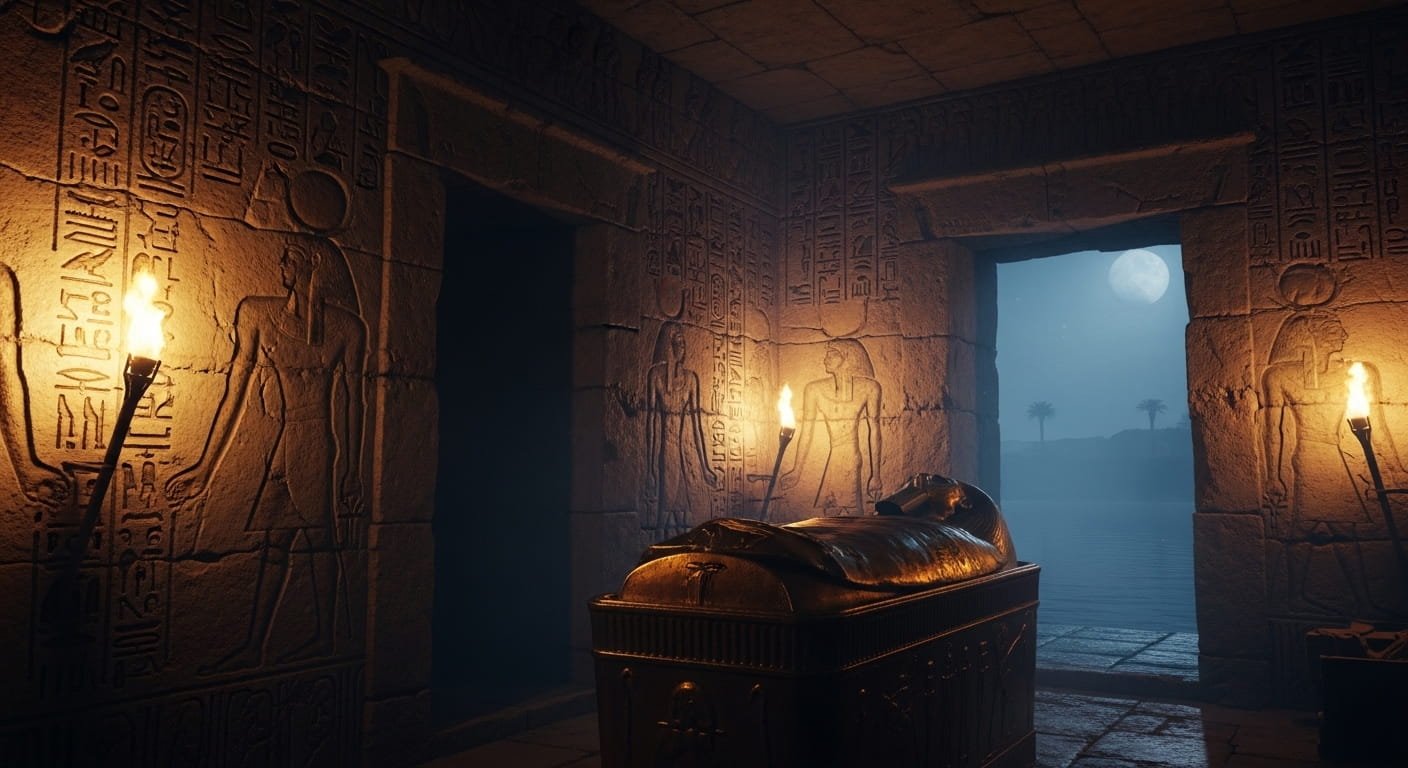
The Pyramids of Giza were more than tombs—they were religious symbols. Ancient Egyptians believed the Pharaoh became a god after death. The pyramid, with its pointed shape, represented the primordial mound and the sun’s rays, aiding the Pharaoh’s journey to the afterlife. Hieroglyphs, funerary texts, and artifacts indicate that burial rituals, offerings, and complex spiritual beliefs guided pyramid design. The alignment with celestial bodies reinforced the connection between earthly and divine realms.
Preservation and Modern Threats
Today, the Pyramids face challenges from:
- Urban expansion in Cairo
- Pollution and acid rain
- Tourism pressure and physical wear
- Natural erosion from wind and sand
Efforts by the Egyptian government and UNESCO aim to protect the pyramids while allowing controlled access for visitors.
Why the Mystery Endures
The Pyramids of Giza construction mystery captivates the world because it represents the pinnacle of human achievement without modern technology. The combination of massive scale, precision, and alignment, along with lost methods and incomplete historical records, ensures that the puzzle continues to inspire curiosity, research, and speculation.
Conclusion
The Pyramids of Giza remain a marvel of ancient engineering and one of history’s greatest mysteries. Despite modern research, how the Egyptians built such precise and massive structures remains unknown. Beyond construction, they reflect spiritual beliefs, cultural genius, and human ambition, continuing to fascinate the world even today.
FAQs
Q1: How were the Pyramids of Giza built?
Ancient Egyptians likely used ramps, levers, sledges, and large coordinated labor forces to construct the pyramids with remarkable precision.
Q2: Why are the pyramids perfectly aligned?
The Great Pyramid aligns with cardinal points and circumpolar stars, reflecting advanced ancient astronomical knowledge.
Q3: Were slaves used to build the pyramids?
Archaeological evidence suggests the workforce was skilled laborers, not slaves, supported by organized housing and provisions.
Q4: Could aliens have built the pyramids?
No credible evidence supports alien involvement; modern archaeology explains construction using ancient engineering methods.
Q5: What is still unknown about the pyramids?
The exact techniques for moving massive stones and constructing interior chambers remain partially speculative, keeping the mystery alive.
Q6: Why were the pyramids built?
They served as tombs for Pharaohs, reflecting religious beliefs in the afterlife and the divine status of rulers.
Q7: How long did it take to build the Great Pyramid?
Estimates suggest construction took approximately 20 years using large coordinated labor teams and seasonal workers.