



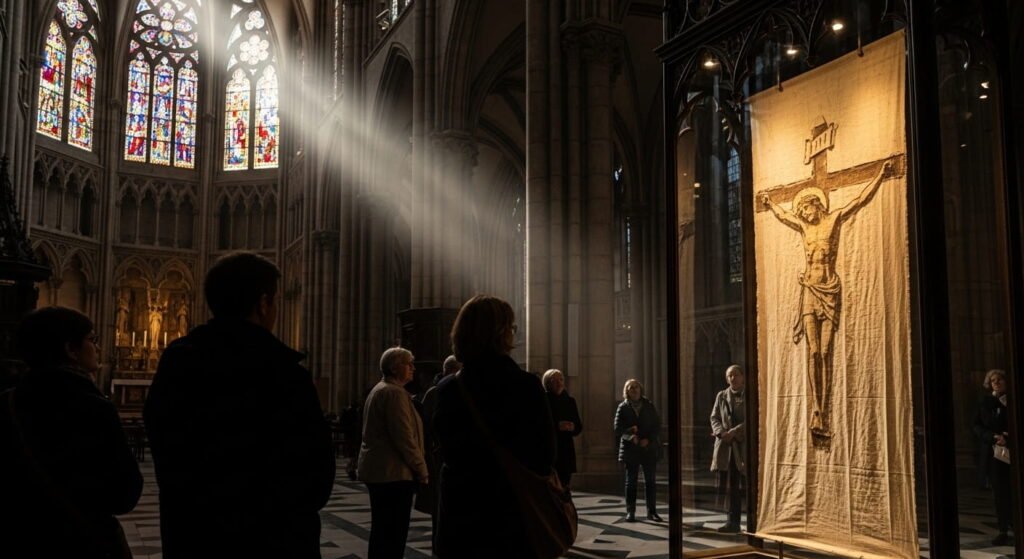

Few relics in history have stirred as much fascination, debate, and controversy as the Shroud of Turin. Preserved in the Cathedral of Saint John the Baptist in Turin, Italy, this centuries-old linen cloth bears the faint image of a crucified man. To many believers, it is the burial shroud of Jesus Christ. To skeptics, it is a medieval forgery.
The Shroud of Turin mystery centers on a single question: how was the image formed on the cloth, and could it truly be associated with Christ’s crucifixion? Over centuries, the Shroud has been examined by scientists, theologians, historians, and even forensic experts. Each study has added pieces to the puzzle, yet no definitive answer has emerged.
This article presents a comprehensive, ultra-detailed exploration of the Shroud of Turin. We examine its history, physical properties, scientific investigations, religious significance, image formation theories, controversies, and cultural impact. By the end, readers will understand why the Shroud continues to captivate imaginations around the world.
Historical Background
The history of the Shroud is complex and often contested. The first undisputed historical record dates back to the mid-14th century in France. It was displayed publicly in Lirey, near Troyes, by a French knight, Geoffroi de Charny. Medieval documents mention a cloth showing the image of Christ, though skeptics argue this could be a different relic.
Before its appearance in France, claims suggest the Shroud may have existed in Constantinople. Some scholars connect it to the Image of Edessa, a cloth with a miraculous depiction of Jesus, although evidence is circumstantial.
The Shroud was eventually moved to Turin in 1578 by the House of Savoy. Since then, it has been preserved carefully, surviving fires, wars, and political turmoil. Its long and well-documented journey has added both legitimacy and mystery to the relic.
Physical Description of the Shroud
The Shroud of Turin is a rectangular linen cloth measuring approximately 4.4 meters long by 1.1 meters wide. Its most striking feature is the faint but detailed front and back image of a man who appears crucified.
Key physical characteristics include:
- Image: Both front and back images of a man with blood stains.
- Blood markings: Wounds consistent with crucifixion, including nail marks in the wrists, lacerations on the scalp, and puncture wounds on the feet.
- Linen weave: Herringbone pattern, typical of medieval European textiles but also consistent with some ancient Egyptian looms.
- Scorch marks and water stains: Remnants from fires, most notably in 1532, when the Shroud suffered a chapel fire in Chambéry, France.
The image is faint, monochromatic, and superficial. Microscopic analysis reveals no pigments, dyes, or brush strokes, making traditional painting techniques unlikely.
Scientific Investigations
Over the past century, the Shroud has undergone extensive scientific scrutiny. Investigations can be broadly divided into radiocarbon dating, chemical analysis, forensic studies, and imaging techniques.
Radiocarbon Dating
In 1988, a small sample of the Shroud was tested in laboratories in Oxford, Zurich, and Tucson. The results dated the cloth to 1260–1390 CE, suggesting a medieval origin. Critics argue the sample may have been contaminated or taken from a repaired section of the cloth, potentially skewing results. Other studies analyzing vanillin content and textile aging suggest the cloth could be older, though these methods are less conclusive.
Chemical Analysis
Analysis of the Shroud’s fibers revealed traces of blood, pollen, and other environmental particles. Experts identified hemoglobin, bilirubin, and protein compounds consistent with human blood. Pollen analysis indicates plants from Palestine and the Middle East, suggesting the cloth may have originated in or traveled through that region. These findings have fueled debate about whether the Shroud could have been in Jerusalem during the first century.
Forensic Studies
Forensic pathologists who have examined the bloodstains and body image note several striking features. The wounds appear consistent with Roman crucifixion practices, and the blood flow patterns align with a body suspended in an upright or semi-upright position. The image also displays detailed facial and anatomical features—including the hands, feet, and torso—with remarkable proportional accuracy. Some researchers argue that these precise details would have been extremely difficult to fabricate in medieval times without advanced knowledge of human anatomy.
Imaging and Digital Analysis
Modern imaging, including ultraviolet, infrared, and 3D scanning, reveals depth and contour in the Shroud’s image. Remarkably, the image encodes three-dimensional information, allowing researchers to generate digital topographical maps of the body.
No known medieval technique could reproduce such 3D effects, strengthening the mystery around the image’s origin.
Religious Significance
The Shroud of Turin holds immense religious importance, particularly in Christianity. Many believe it is the actual burial cloth of Jesus Christ, containing the only physical imprint of his crucifixion.
Over centuries, the Shroud has been venerated in numerous churches and public displays. Pilgrims travel from around the world to see it, often experiencing deep spiritual reflection. Catholic Church authorities have never officially declared it authentic but have recognized its religious significance and encouraged respectful veneration.
Theories on Image Formation
Scholars and scientists have proposed several explanations for how the image appeared:
1. Natural Chemical Reactions
Some theories suggest the image formed due to chemical reactions between sweat, body oils, and burial spices on the linen. This could account for coloration and superficial staining without pigments.
2. Artistic Forgery
Skeptics argue the Shroud could be a medieval artistic creation using painting or rubbing techniques. However, microscopic studies have failed to identify pigments, brush strokes, or typical artistic binders.
3. Radiation or Supernatural Events
A controversial theory suggests a burst of radiation, possibly at the moment of resurrection, imprinted the image onto the cloth. While not scientifically verifiable, this hypothesis persists in religious and fringe literature.
4. Unknown Ancient Technology
Some researchers speculate that the image may have been created using an ancient photographic or chemical process unknown to modern science. While speculative, this theory highlights the technical complexity of the Shroud.
Controversies and Debates
The Shroud of Turin has long been the subject of heated debate. Questions of authenticity have arisen, with radiocarbon dating suggesting a medieval origin, while other scientific evidence challenges this timeline. Allegations of forgery contrast with forensic analyses that point to highly detailed anatomical accuracy. Religious perspectives also vary, with some viewing the Shroud as a sacred relic and others considering it a symbolic object. Despite centuries of research, the Shroud continues to provoke polarized opinions, ensuring that its mystery remains alive.
Modern Research and Discoveries
Recent studies of the Shroud of Turin have employed cutting-edge technology to uncover new insights. Multispectral imaging has revealed minute details invisible to the naked eye, while 3D laser mapping captures depth information from bloodstains and image contours. Particle analysis has detected soil, pollen, and mineral traces consistent with a Middle Eastern origin. These advanced studies deepen the mystery of the Shroud, confirming that while some aspects may be natural, others remain unexplained.
Cultural Impact
The Shroud has influenced art, literature, films, and media. From medieval manuscripts to modern documentaries, it inspires debate, devotion, and fascination. Popular culture often emphasizes the miraculous or supernatural aspects, fueling curiosity far beyond religious circles.
Why the Mystery Persists
The allure of the Shroud of Turin lies in its many unresolved questions. How was the image created? Could it truly be the burial cloth of Jesus? Why does it encode three-dimensional information, and how did it survive centuries of handling, fire, and exposure? No single explanation satisfies both skeptics and believers, making the Shroud a lasting symbol at the intersection of faith, science, and history.
Conclusion
The Shroud of Turin remains one of the most compelling relics in human history. Its mysterious image, complex history, and combination of scientific, religious, and cultural significance make it a source of fascination for millions. While modern studies shed light on some aspects of the cloth, including bloodstains, pollen, and linen composition, no explanation fully accounts for the image’s formation or the Shroud’s survival over centuries. Whether one approaches it as a religious relic, historical artifact, or scientific enigma, the Shroud of Turin continues to inspire curiosity, debate, and awe — preserving its place as one of the greatest mysteries of the world.
FAQs
Q1: What is the Shroud of Turin?
The Shroud of Turin is a centuries-old linen cloth bearing the faint image of a crucified man, believed by some to be Jesus Christ.
Q2: Where is the Shroud of Turin kept?
It is preserved in the Cathedral of Saint John the Baptist in Turin, Italy.
Q3: Has the Shroud been scientifically tested?
Yes. It has undergone radiocarbon dating, chemical analysis, forensic studies, and modern imaging, yet its origin remains debated.
Q4: Is the Shroud of Turin authentic?
Authenticity is disputed. Radiocarbon dating suggests a medieval origin, while other studies indicate older origins, leaving the question unresolved.
Q5: How was the image on the Shroud formed?
Theories include natural chemical reactions, medieval artistic methods, radiation or miraculous events, and unknown ancient techniques.
Q6: Why is the Shroud of Turin important to Christians?
It is venerated as a possible burial cloth of Jesus, representing his crucifixion and resurrection.
Q7: Has modern technology revealed new details?
Yes. 3D imaging, ultraviolet and infrared scans, and particle analysis have revealed image depth, pollen from the Middle East, and fine anatomical details.