




The Voynich Manuscript is widely regarded as the most mysterious book in the world. Its strange script, bizarre illustrations, and undeciphered content have baffled historians, linguists, cryptographers, and scientists for over a century. Radiocarbon dating confirms that the manuscript dates back to the early 15th century, making it a genuine medieval artifact.
The Voynich Manuscript has been described as an unsolvable code, a lost alchemical text, or even a medieval encyclopedia of unknown knowledge. Scholars debate its origins, purpose, and authorship. Was it a practical handbook for medicine or astronomy, a philosophical text, a hoax, or a complex cipher?
In this article, we will explore every aspect of the Voynich Manuscript, from its discovery and historical background to its content, physical features, linguistic analysis, and modern research, providing a complete guide to understanding this perplexing artifact.
Discovery and History
Wilfrid Voynich and the Manuscript’s Rediscovery
The manuscript is named after Wilfrid Voynich, a Polish-American antiquarian who discovered it in 1912 at a Jesuit college in Villa Mondragone, Italy. Voynich recognized the manuscript’s uniqueness and historical significance, bringing it to the attention of scholars worldwide.
Before Voynich’s discovery, the manuscript had passed through several owners, possibly including Emperor Rudolph II of the Holy Roman Empire, who is rumored to have purchased it as an alchemical work. However, the details of its early history remain uncertain, adding to its enigmatic reputation.
Dating and Provenance
Scientific analysis has played a key role in establishing the authenticity of the Voynich Manuscript. Radiocarbon dating of the vellum places its creation between 1404 and 1438, providing a clear historical timeframe. Chemical analysis of the inks and pigments shows that they are consistent with medieval European production techniques, further supporting its authenticity. In addition, handwriting analysis indicates that the calligraphy style aligns with early 15th-century origins, likely from Central Europe. Together, these findings confirm that the Voynich Manuscript is a genuine medieval artifact, adding to its historical and scholarly significance.
Physical Description
The manuscript consists of approximately 240 vellum pages, though some pages appear to be missing. Each page contains illustrations, diagrams, and handwritten text in an unknown script now called Voynichese.
Sections of the Manuscript
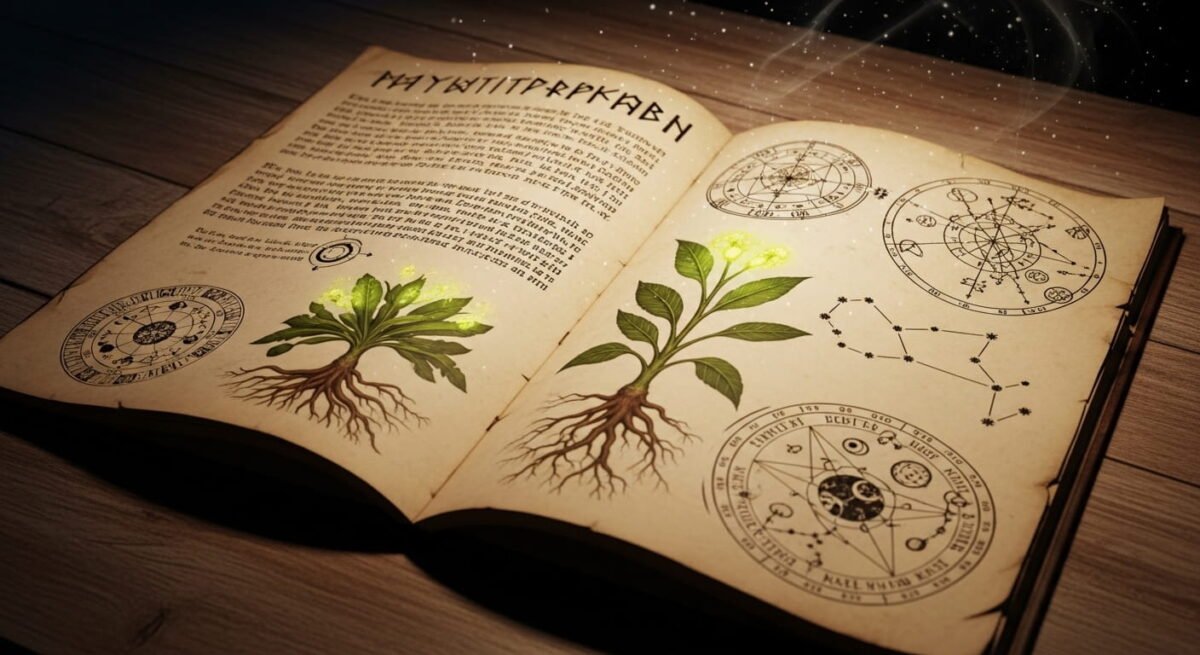
- Botanical Section: Illustrations of over a hundred plants, many unidentifiable, accompanied by text that might describe their properties or uses.
- Astronomical and Astrological Section: Diagrams of stars, moons, and zodiac signs, suggesting a possible connection to celestial observation or astrology.
- Biological Section: Drawings of naked female figures, often in pools connected by tubes, which may represent medicinal, alchemical, or symbolic concepts.
- Pharmaceutical Section: Depictions of jars, containers, and plant parts, possibly indicating early herbal remedies or potion recipes.
- Recipes Section: Pages filled with short paragraphs of repetitive text, which could indicate instructions, formulas, or coded recipes.
The illustrations are drawn with care and precision, demonstrating that the manuscript was a labor-intensive work, possibly commissioned by a wealthy patron or a scholarly institution.
The Script and Language Mystery
The most fascinating aspect of the Voynich Manuscript is its text. Written in an unknown script, it has defied all attempts at decipherment. Linguists, cryptographers, and codebreakers have analyzed it extensively, using both manual and computational methods.
Characteristics of Voynichese
- Unique Characters: The script contains over 20 distinct characters and unique ligatures.
- Consistent Structure: Statistical analysis shows patterns consistent with natural language, including repeated words, prefixes, and suffixes.
- No Known Language: Despite extensive comparison with Latin, Hebrew, Greek, and other medieval languages, Voynichese does not match any known alphabet or language.
Some researchers propose that it may be a constructed language, a cipher, or even an elaborate hoax. Others suggest it could encode lost knowledge about plants, medicine, or science.
Linguistic and Cryptographic Studies
Early Cryptanalysis
During the early 20th century, cryptographers attempted to decode the manuscript using classical cipher techniques, assuming it was a substitution or monoalphabetic cipher. None succeeded.
Modern Computational Analysis
With the advent of computers and artificial intelligence, researchers have applied advanced tools to study the Voynich Manuscript. Pattern recognition software has been used to analyze word frequency, repetition, and structural patterns within the text. Machine learning models have suggested possible correlations with Indo-European languages or early Romance languages, though no verified translation has yet been achieved. Additionally, entropy analysis indicates that the text is not random, implying that it likely encodes meaningful content, even if its precise language and purpose remain a mystery.
The Hoax Theory
Some scholars argue the manuscript was deliberately constructed to appear mysterious, using invented words and patterns to imitate a language. However, the effort, time, and consistency of the manuscript make this explanation less plausible to many experts.
Botanical and Astronomical Mysteries
Unknown Plants
The manuscript’s plant illustrations are mostly unidentifiable, with features of multiple species combined. Some theories suggest the plants are symbolic, while others propose they document lost or extinct species.
Celestial Diagrams
The astronomical sections include moons, stars, and constellations, often arranged in circular diagrams. Some researchers believe these represent astrological charts, lunar calendars, or observations of celestial events.
Medical and Alchemical Connections
- The biological and pharmaceutical sections may indicate early herbal medicine or alchemical practices.
- Tubes connecting human figures to pools could represent medicinal baths, blood flow, or symbolic connections between body and nature.
Theories About Its Purpose
Scholars have proposed numerous explanations for the Voynich Manuscript, reflecting its mysterious and enigmatic nature. Some suggest it was an herbal or medical guide, documenting plants, medicines, and procedures for practitioners. Others consider it an alchemical or esoteric work, intended as a symbolic text for mystical or philosophical study. Another theory is that it served as a cipher, encoding secret knowledge for a select audience. Some believe it could have been an artistic or intellectual hoax, created to impress or deceive wealthy collectors. There are also suggestions that it represents a lost scientific text, recording early experiments in astronomy, botany, or other fields. Despite these varied theories, no single explanation has been universally accepted, which only adds to the manuscript’s enduring allure.
Modern Research and Discoveries
Recent advances in technology have deepened our understanding:
- Multispectral Imaging: Reveals faint erased annotations and hidden drawings.
- Ink and Pigment Analysis: Confirms medieval materials and techniques.
- Radiocarbon Testing: Confirms vellum dates and authenticity.
- AI Analysis: Suggests linguistic patterns that resemble human language structure.
Despite these advances, no researcher has yet produced a widely accepted translation or definitive explanation.
Cultural Impact and Legacy
The Voynich Manuscript has had a profound influence on literature, media, and popular culture. It has inspired countless books and novels that explore themes of lost knowledge, secret codes, and hidden civilizations. The manuscript has also appeared in movies and documentaries focused on mysteries, codes, and secret societies, capturing the imagination of audiences worldwide. In academia, it continues to attract the attention of cryptographers, historians, linguists, and computer scientists, all eager to unravel its secrets. Beyond scholarly circles, the manuscript has fueled popular fascination, inspiring hobbyist codebreakers, amateur historians, and enthusiasts around the globe. Today, it remains a powerful symbol of humanity’s enduring curiosity about the unknown and the limits of our understanding of historical knowledge.
Conclusion
The Voynich Manuscript is a window into a mysterious medieval world, blending art, science, and possibly esoteric knowledge. Its undeciphered text, strange illustrations, and unknown origin make it one of the greatest unsolved historical puzzles.
While modern science and computational tools have revealed aspects of its history and production, the manuscript’s meaning remains elusive. Whether a practical handbook, a coded text, or an elaborate intellectual creation, the Voynich Manuscript continues to intrigue scholars and the public alike. Its enduring mystery is a reminder of the limits of human knowledge and the allure of ancient secrets yet to be understood.
FAQs
1. Who wrote the Voynich Manuscript?
The author is unknown; no historical records reveal its creator.
2. What is Voynichese?
Voynichese is the manuscript’s unique script, which has never been deciphered.
3. When was the Voynich Manuscript created?
Radiocarbon dating confirms it was made between 1404 and 1438.
4. Is it a hoax or genuine?
Analysis confirms it is a genuine medieval manuscript; whether its content is meaningful is debated.
5. Where is the Voynich Manuscript now?
It is housed at the Beinecke Rare Book & Manuscript Library, Yale University.